When you can start chasing
You can chase from the day after the due date. If you and the customer never agreed a payment date, GOV.UK says the payment is late 30 days after the customer gets the invoice or you deliver the goods or service, whichever is later. Send every reminder by email, so you've got a record.
If you're not sure your invoice has everything on it, see our guide to what an invoice must include.
Four steps, from reminder to court
Step 1: Friendly reminder (a few days after the due date)
Subject line: Invoice [number] from [date].
Body:
Hi [name],
Hope all's well. Just a quick reminder that invoice [number] for £[amount] was due on [date]. If it's already on its way, please ignore this. If not, the payment details are on the invoice.
Thanks,
[Your name],
[Business]
Step 2: Firmer follow-up (about two weeks overdue)
Subject: Overdue: invoice [number], £[amount].
Body:
Hi [name],
Invoice [number] for £[amount], due on [date], still hasn't been paid. Could you arrange payment within 7 days of this email, or let me know if there's a problem I can help sort out?
If it's still unpaid after [date], I'll start charging statutory late-payment interest under the Late Payment of Commercial Debts (Interest) Act 1998. Thanks,
[Your name]
Step 3: Letter before action (about four weeks overdue)
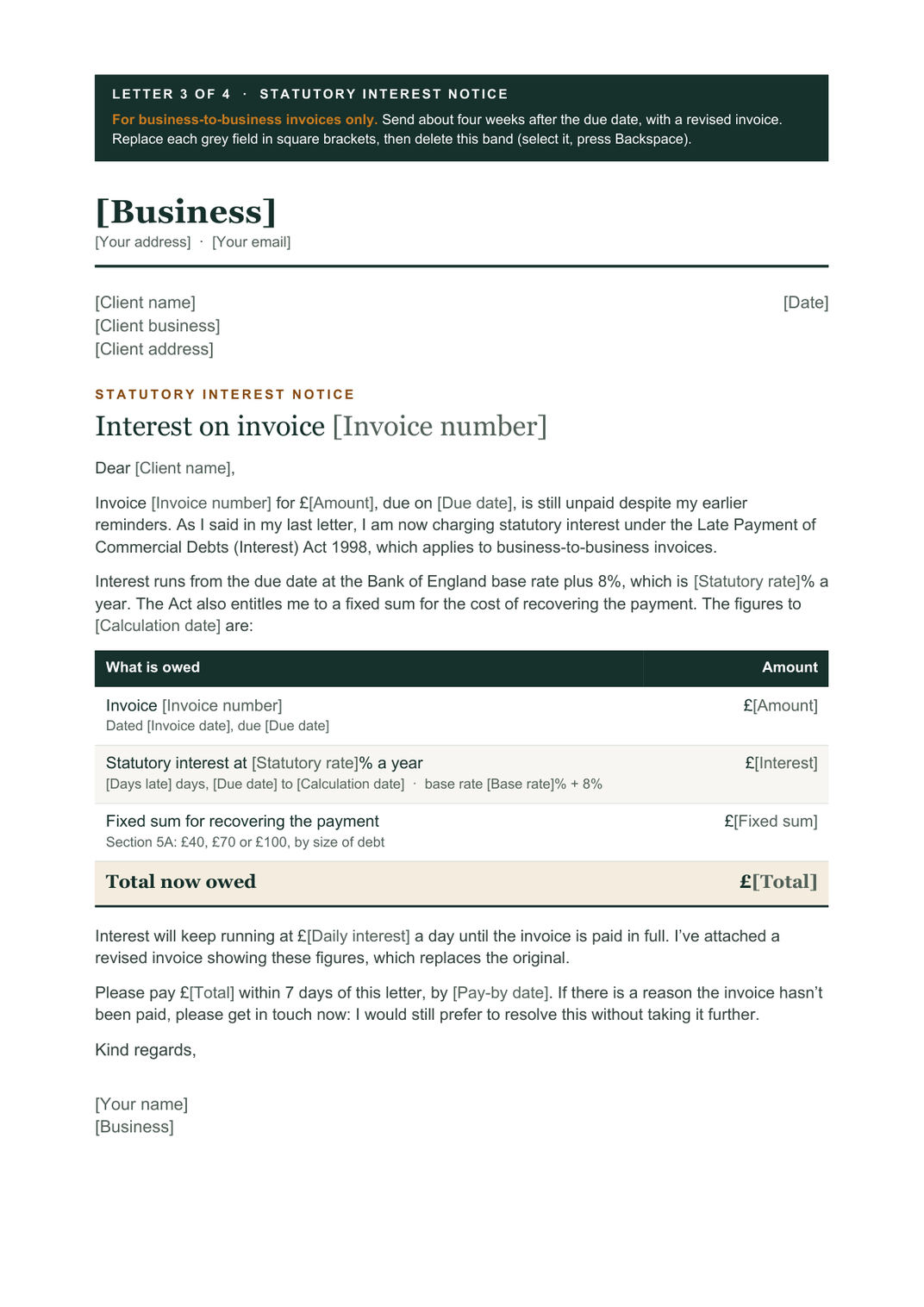
This is your formal final notice. Set out the amount owed, the statutory interest you're entitled to, any fixed compensation and the total. Give them 14 days from the date of the letter, and if they still don't pay, start a court claim (step 4). GOV.UK advises sending a new invoice if you decide to add interest to what you're owed.
Subject: Final notice: invoice [number] (£[amount]).
Body:
Dear [name],
I am writing about invoice [number] for £[amount], due on [date], which has not been paid. In addition to the original amount, I am entitled to statutory interest at [rate]% a year from [due date] under the Late Payment of Commercial Debts (Interest) Act 1998, and to fixed compensation under section 5A of the same Act.
The total now owed is £[total]. Please pay within 14 days of this letter. If I have not received payment by [date], I will issue court proceedings without further notice and will also seek to recover my reasonable costs.
Step 4: Small claims court (if it's still unpaid)
England and Wales. You can make a money claim online through GOV.UK (gov.uk/make-court-claim-for-money). You can't use it if the customer has no address in England or Wales, if you're claiming against three or more people or organisations, or if you don't know the amount. Claims of up to £10,000 are generally dealt with on the small claims track, and you don't need a lawyer. The court fee depends on the amount you claim, including interest: £35 for up to £300, £205 for £3,000.01 to £5,000, and £455 for £5,000.01 to £10,000. You generally can't recover your own legal costs on the small claims track, though you may get the court fee back if you win. For a very small debt, compare that with simply writing it off as an expense.
Scotland and Northern Ireland. Each has its own process, separate from the England and Wales online service. GOV.UK points to mygov.scot for Scotland and to nidirect for Northern Ireland. If your customer or your case is there, follow those instead of the steps above.
What you can claim: statutory interest and compensation
The Late Payment of Commercial Debts (Interest) Act 1998 covers business-to-business invoices. It doesn't cover consumers buying for personal use. You don't need a clause in your contract for it to apply. A contract can set a different rate of interest instead, but only with a remedy that counts as substantial. Interest runs from the due date at the Bank of England base rate plus 8% a year. In September 2026 that's 3.75% + 8% = 11.75%. The rate changes when base rate does, so check bankofengland.co.uk.
| Debt size | Fixed sum |
|---|---|
| Up to £999.99 | £40 |
| £1,000 to £9,999.99 | £70 |
| £10,000 or more | £100 |
You get the fixed sum as well as the interest. GOV.UK also says a supplier can claim reasonable costs each time they try to recover the debt.
As an example, a £2,000 invoice paid 30 days late at 11.75% earns about £19 in statutory interest. Add the £70 fixed sum for that size of debt and you can claim about £89 in total.
When to stop chasing
In England, Wales and Northern Ireland a debt becomes statute-barred six years after it fell due. In Scotland the prescriptive period is five years. If the client goes bust, or the amount is small compared with the court fee, write it off as a business expense.
Start with a clear invoice
It's much easier to chase an invoice that says exactly when payment is due. Our free invoice generator puts the terms on for you.
Invoice Generator
Line items, totals with VAT if you need it, and your payment terms. Takes a couple of minutes.
Open the tool →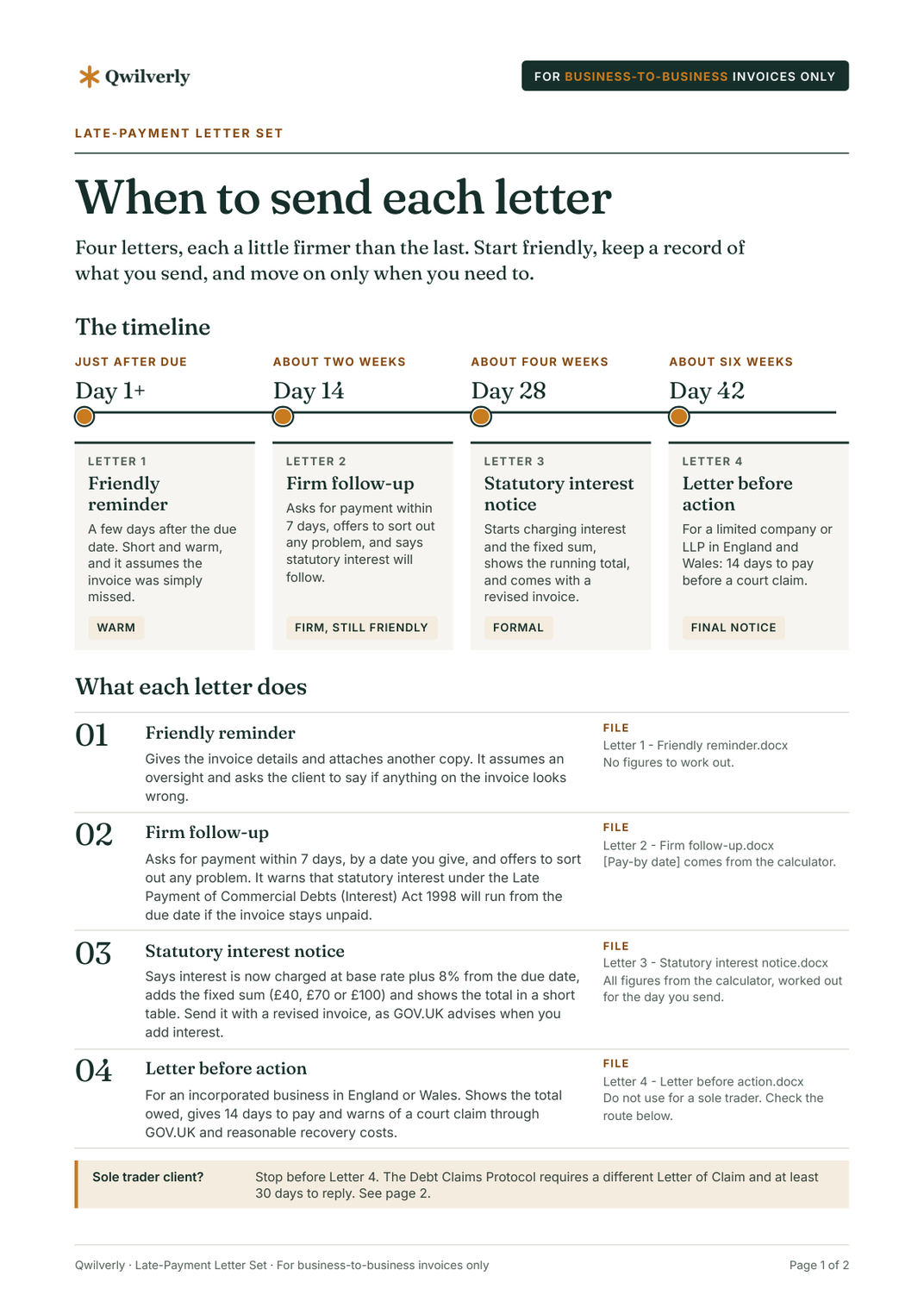
 Four letters · Calculator · Guide
Late-Payment Letter Set, £9
Follow up in stages with editable letters, an interest calculator and a guide to when each letter fits.
See the letter set →Need contract terms before the invoice goes out? The Sole Trader Starter Pack includes a client contract with late-payment clauses.
Common late payment questions
When can I start charging late payment interest?
From the day after your invoice was due. Under the Late Payment of Commercial Debts (Interest) Act 1998 it applies automatically to business-to-business invoices, so you don't need a clause or a reminder first. If you didn't agree a payment date, payment is late 30 days after the customer gets the invoice or you deliver the goods or service, whichever is later.
How much is statutory late-payment interest in 2026?
The Bank of England base rate plus 8% a year. With Bank Rate at 3.75%, that's 11.75% at the moment. It moves when base rate moves, so check bankofengland.co.uk before you quote a figure.
Do I need late-payment terms in my contract?
No. The statutory rights apply anyway. A contract can only replace them with its own late-payment remedy that counts as substantial, so be careful about relying on a clause with a lower rate. Stating your terms (we'd suggest payment within 7 days) still helps, because the client knows where they stand and chasing is easier.
What if they still don't pay after all that?
Send a letter before action, then make a court claim. In England and Wales you can do it online through the GOV.UK money claims service, and claims of up to £10,000 generally go on the small claims track, where you can represent yourself. Scotland and Northern Ireland have their own processes, which GOV.UK links to from its "Make a court claim for money" guide.
How long can I keep chasing a debt?
Six years from when it fell due in England, Wales and Northern Ireland, and five years in Scotland. In England and Wales a written acknowledgment or a part-payment can restart the clock, which is one more reason to chase by email.
Sources: GOV.UK, Late commercial payments: charging interest and debt recovery (8% plus base rate, fixed sums of £40, £70 and £100, default 30-day rule); GOV.UK, Make a court claim for money (court fees, England and Wales online claims, separate Scottish and Northern Irish processes); Late Payment of Commercial Debts (Interest) Act 1998 (sections 5A and 8); Bank of England Monetary Policy Summary, 17 September 2026 (Bank Rate 3.75%); Limitation Act 1980. Figures correct as of September 2026. This guide isn't legal advice.